.png)
.svg)

Leadership communication is performance, but not in the fake or theatrical sense. Similar to an actor, a leader may have an audience, an objective, a message, a body, a voice, and a moment that will never happen the same way twice.
Actors understand something that many business leaders overlook. Communication only occurs when meaning reaches another person.
A leader can have the right strategy, the right data, the right message, and the right intention. Yet if the delivery lacks clarity, energy, physical presence, or connection, the message may not be received as intended.
Acting technique offers a practical way to strengthen how leaders communicate in meetings, presentations, feedback conversations, all-hands, board discussions, and one-on-ones. A leader must aim to be clear, dynamic, intentional, and engaging.
Clarity Drives Connection
Think about the last time a leader you respect communicated something important. Was the message easy to follow? Could you understand where one thought ended and another began?
Clear means easy to see, understand, hear, or free from obstruction. In communication, clear means the person or team listening can follow the speaker’s thoughts and ideas.
Clarity seems simple, but leaders can lose sight of it when the stakes are high. A critical message can get cluttered with unnecessary context, qualifiers, caveats, abstractions, and hurried transitions.
Acting technique teaches the value of articulation, breath, thought breaks, and intention. An actor does not simply recite a block of text. An actor finds the thoughts inside the text and breaks them apart. Each thought has its own shape. Each thought has a beginning, middle, and end. The actor tries to have each thought land in its own unique way.
Leaders can use the same technique.
Before an important conversation, write down the major points. What is the opening idea? What is the shift? What point must land? What needs a pause? What can be removed?
Clear communication gives the listener structure and meaning without them having to work too hard.
Dynamic Communication Keeps Attention
Dynamic communication keeps attention. Think of a contour as the shape of a landscape. A flat presentation sounds like one long line of sameness. A dynamic presentation has movement. It rises, settles, accelerates, slows down, sharpens, softens, and pauses.
A strong communicator will vary the listener’s experience enough to keep the listener engaged.
A dynamic communicator uses contrast, pitch, pace, and volume changes. Silence is also an important element.
The next time you are preparing a presentation, consider whether a keyword may need more emphasis. A difficult truth may need silence, or a call to action may need more energy.
Without dynamic contouring, the listener may drift. People multitask, tune out, or nod along without absorbing the point. Do not mistake politeness for alignment.
You can practice by taking one sentence and saying it in various ways. First, say it like a statement. Next, ask a question. Now, say it faster. Say it slower. Pause before the final phrase. Lower the volume to pull people in. Finally, raise the energy to create urgency.
Define the Objective of the Communication
Actors work with objectives. A character wants something. Leaders need the same discipline.
Before speaking, a leader should ask, “What is the task?” In other words, what does this communication need to accomplish?
The task may be to align the team on the company vision. It may be to inspire confidence after a hard quarter. It may be to secure a budget or create urgency.
Know your objective before you start to speak. What response should the communication create? What should the listener understand, feel, decide, or do afterward?
Once the task becomes clear, the message becomes easier to shape.
Choose a Tactic to Meet the Need
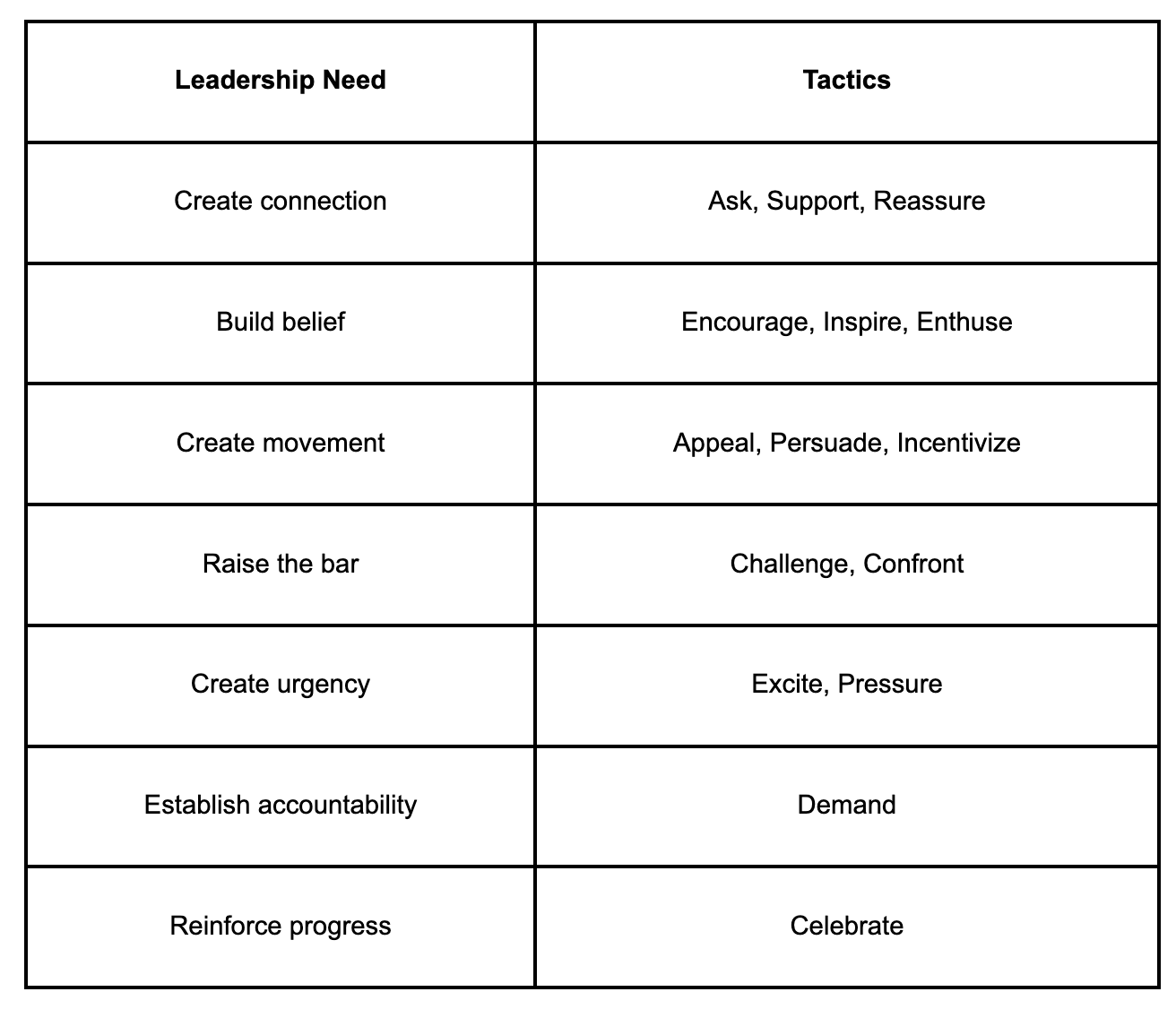
The tactic is the method. A leader might need to reassure, challenge, invite, simplify, coach, celebrate, or redirect. The tactic changes the delivery. The same sentence can land differently depending on the tactic behind it. A tactic is a way you try to influence another person.
“We need to talk about the forecast” can sound curious, urgent, supportive, or strategic. The words matter, but the tactic beneath them shapes the listener’s experience.
Leaders often default to one or two tactics. Which ones are your default? A leader trained in acting technique can pause and ask what the best tactic for the moment is. Below is a table of tactics that map to specific leadership needs.
The Voice as an Instrument of Leadership
The voice is an instrument of leadership. Practice using your voice just like you would practice playing piano. Pitch is one practical place to start. Many people speak within a narrow pitch range, especially when nervous or in formal settings.
A leader can warm up the range of their voice. Practice speaking at a high pitch, a low pitch, and then somewhere in between. Greater pitch flexibility creates expressive possibilities.
Pace is another powerful vocal tool. Leaders may rush when excited. Speed can communicate energy, but too much speed creates confusion. Slowing down gives ideas room to breathe and be absorbed. A deliberate pause after an important point helps the listener catch up and process the information and message they are receiving.
Volume matters. A leader can use a louder voice to grab attention, but speaking softly can also engage people when done intentionally. Enunciation also supports clarity. Important words need to be heard. Names, numbers, dates, decisions, and calls to action deserve precision.
Start paying attention to your speaking habits. Do you rush your words? Do you stick to one pitch? Does each sentence end the same way? Do you get quieter or louder at the most important part of your message? Notice how you sound and how others receive your message differently based on your tone.
Physical Centers
Communication does not only come from the voice. The body speaks before the words arrive. That is why body language is literally described as a language. Posture, movement, gestures, facial expressions, and physical orientation all communicate information to another person.
Think back to that leader you admire. How do they stand or sit while delivering their message? Do they stand still, gesture, or bounce? How do they engage you with physical gestures?
Just as a monotone voice can undercut a message, so can a collapsed body. Restless movement can also distract from an important point. A tight jaw can make openness and care feel false. A leader who looks down while asking for commitment may inadvertently weaken their ask.
Actors work with physical centers to understand how a character moves. Some people move from the chest, with openness and warmth. Some lead from the head, with analysis and precision. Some lead from the gut, with instinct and force.
Before your next important conversation, stand in a neutral position. Feet grounded with your knees unlocked. Lift your spine and relax your hands. From there, choose the physical presence that serves the moment and the experience you want to create for your listener.
A difficult feedback conversation may need grounded calm with your feet physically on the floor. A strategy presentation to the board may need the energy that comes from a lifted chest. A negotiation may need stillness to signal intense listening and understanding.
Your body is part of the conversation. Use it to help communicate the message you intend to send.
Rehearse, Then Discover
One of the most useful acting lessons for leaders is the paradox of preparation. Actors rehearse so the moment can feel alive. The work gets practiced, scored, and shaped. Then, in performance, the actor must rediscover it as if it is happening for the first and only time.
Leaders need this same discipline. A leader should rehearse the message. Practice your opening lines for the all-hands. Know the objective and choose the tactic. Work your voice and ground your body. Then, when the moment arrives, pay attention to the actual people in the room and be ready to adjust to their needs.
Every meeting, presentation, and conversation happens once. Even if the leader has given the message before, the current listener has not received it at this exact moment. The leader’s job is to make the communication feel alive in this unique moment in time and space.
Leadership communication is a craft. It can be studied, practiced, and improved. Acting technique gives leaders a practical way to work on that craft.
Bottom Line
Leadership communication is only complete when meaning reaches another person. As a leader, choose how you want to affect the person in front of you. Use your voice and body to support your intended message. Rehearse, but pay attention to what is actually happening in the room.
Your message should be clear enough to follow, dynamic enough to hold attention, and responsive enough to adapt to the people in front of you.
Communication is a leadership craft. Practice it.

.svg)
.svg)
.svg)
.svg)


.svg)


.svg)
.svg)